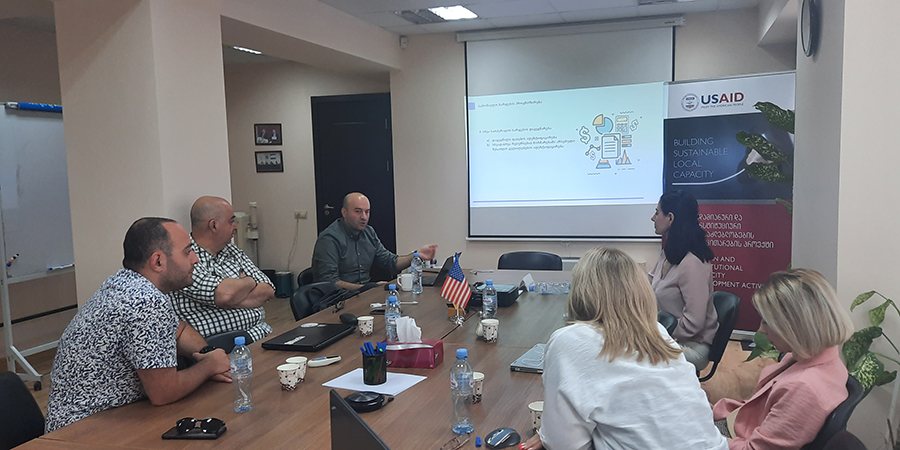
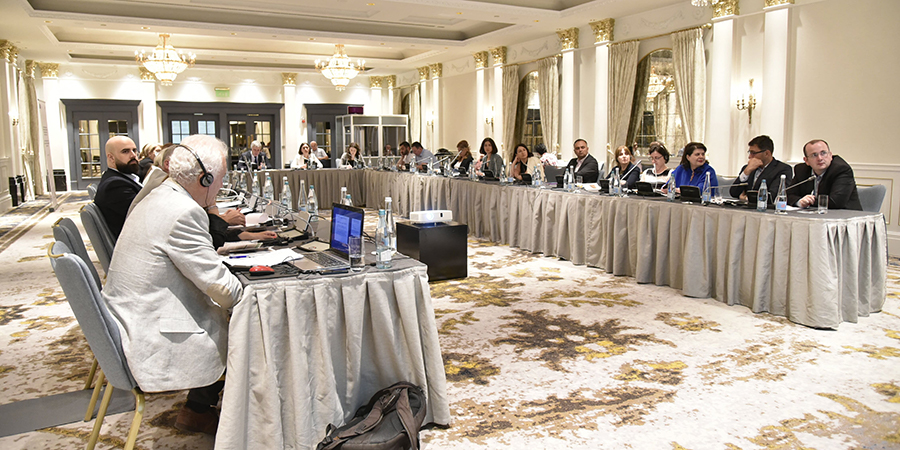
PMCG recently started working on a new project entitled “Regulatory Impact Assessment (RIA) on Economic Reforms - Tax Dispute Resolution” which is being implemented within the USAID Economic Governance Program and is aimed at addressing the current shortcomings of the tax dispute resolution (TDR) system and to align it with good international practices, ultimately leading to the realization of a fair, effective, and efficient TDR system.
In order to achieve the project goals, the project aims to develop more than one potential scenario for TDR system reform and to carry out regulatory impact assessment (RIAs) for these envisaged options.
To ensure close collaboration between the beneficiary and the implementing company, as well as to increase the legitimacy and quality of the final RIA report, PMCG will facilitate participation of the beneficiary and other stakeholders, including those in the business sector, as well as tax advisors and tax policy experts during all major steps of the RIAs. The team will ensure that all relevant stakeholders are consulted, with the time constraint of the project taken into account.
PMCG will support the Georgian government in further improving the business climate by enhancing the quality of the administrative tax review process and implementing tax dispute procedures based on good-practice principles derived from the best international experience.
“The reform is intended to contribute to better tax and legal certainty, increased public confidence in the Georgian tax regime, and improved self-compliance by enabling the resolution of tax disputes, without litigation, on a basis which is fair and impartial to both the Government and the taxpayer,” said David Tomadze (Team Leader/Tax Expert).
By the end of the project, the beneficiary will be issued a recommendation for the TDR system’s reform based on a comparison of more than one policy option designed to best achieve the program objectives.
Based on PMCG’s recommendations, a well-designed administrative process for reviewing tax decisions can be realized to enable the Ministry of Finance and the Revenue Service to take informed decisions on the optimal way forward in reforming the TDR system in line with the program objectives. It will also contribute to improving the business climate by quickly and accurately identifying errors in tax administration, increasing legal certainty, and lowering compliance costs for taxpayers, as well as enhancing the credibility and legitimacy of the tax regime.
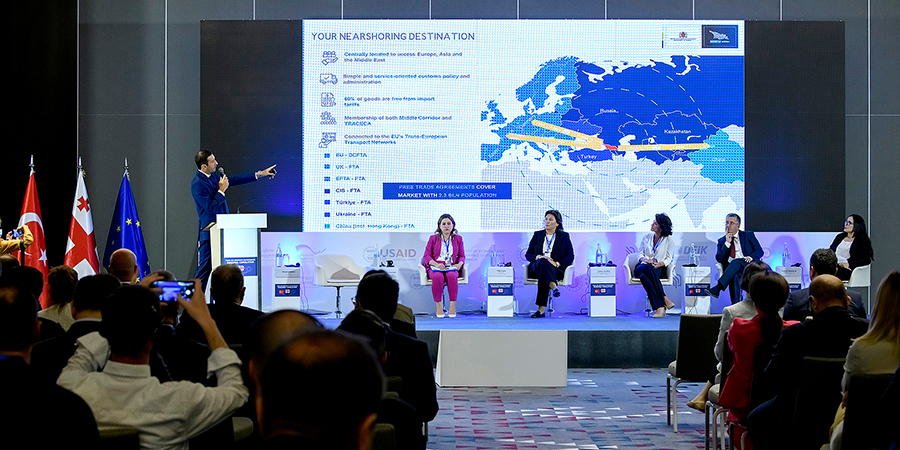
On September 9, we presented the findings of the research entitled “Investment and Export Promotion via Diagonal Cumulation between Georgia, Türkiye, and the European Union” at a forum organized by the Ministry of Economy and Sustainable Development of Georgia with the support of the USAID Economic Security Program, the EU, and GIZ.
We recently started working on a new project entitled “Communal Infrastructure for Environment and Tourism Improvement - Lot 2: Accompanying Measures,” aimed at improving the living conditions of people in four Georgian municipalities (Baghdati, Vani, Samtredia, and Kazbegi) through improving the supply of hygienically-sound drinking water and environmentally-safe sanitation infrastructure.
We recently completed a project entitled “Executive Roundtable (ERT) Session on Non-Profit Budgeting Process,” carried out by the USAID HICD Activity and implemented by the Kaizen, Tetra Tech company, aiming to facilitate collaboration, collective learning, and organizational development in the non-profit budgeting process with a cohort of selected organizations, including the Georgian Young Lawyers Association (GYLA), the Georgian Institute of Politics (GIP), and the Georgian Association of Social Workers (GASW).
On September 19-23, the International Consortium on Governmental Financial Management (ICGFM) is hosting the 2022 International Conference at the University Club of Washington DC, offering the first opportunity in over two years for the global PFM community to gather in-person to network and connect with leading professionals and colleagues from across the world, in a unique and distinguished setting.
On July 28, PMCG supported a workshop organized by the EU and the Ministry of Environmental Protection and Agriculture of Georgia as part of the project “Support to Environmental Protection and Fight Against Climate Change in Georgia.”
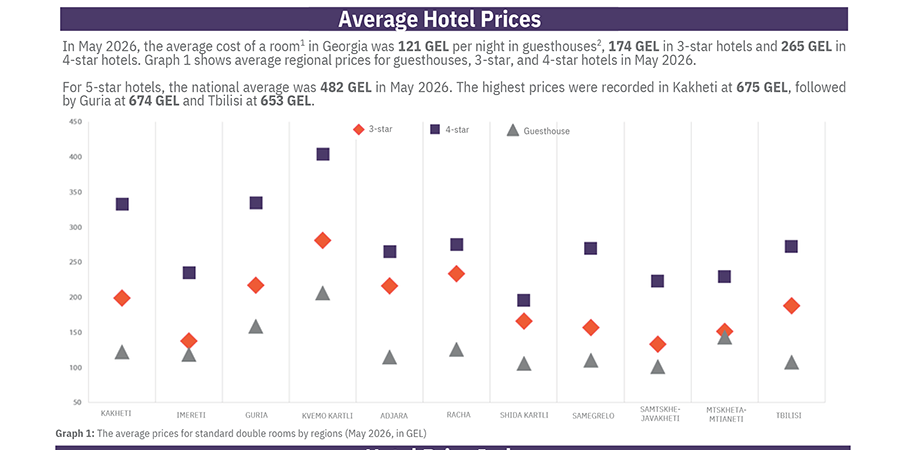
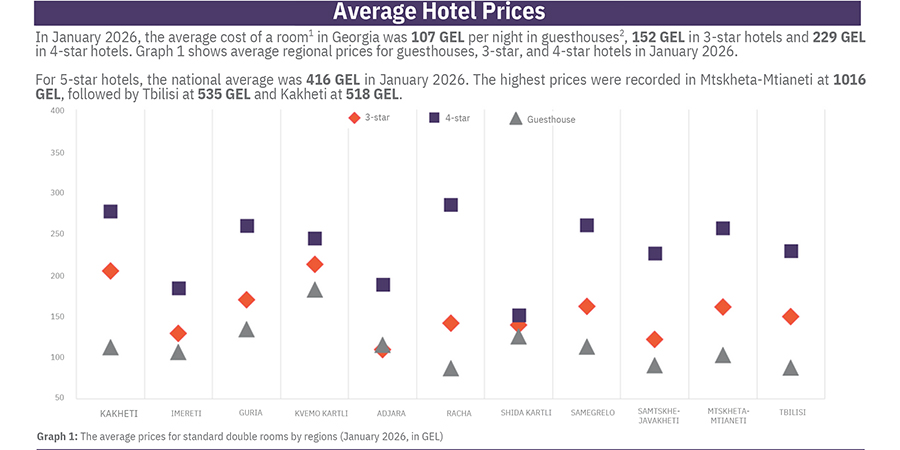
In May 2026, hotel price index in Georgia increased by 11.8% MoM, with the largest increase observed in Kvemo Kartli, Adjara, and Tbilisi compared to previous month. In May 2026, hotel price index in Georgia increased by 8.7% YoY, with the largest increase in Adjara, Guria, and Kakheti. The average price of a room ranged from 121 GEL to 482 GEL in May 2026.
In April 2026, the number of salaried employees reached 1,012,141, increasing by 2.1% year-over-year. In April 2026, vacancies published on jobs.ge decreased by 5.2% year-over-year. Within this, vacancies in sales and procurement increased by 5.7%, while vacancies in IT and programming decreased by 17%. In Q1 2026, compared to Q4 2025, the efficiency of the labor market decreased, as the seasonally adjusted job openings rate remained unchanged, while the unemployment rate increased.
In 2025, Georgia’s economy grew by 7.5% in real terms, moderating from 9.7% growth in 2024. Economic expansion was driven mainly by ICT, education, and transport services on the supply side, alongside strong private consumption on the demand side. Economic activity remained robust at the beginning of 2026, with real GDP growth reaching 9.1% year-over-year (YoY) in Q1 2026. Issue 10 of the Macro Overview examines key aspects of Georgia’s economy and beyond, including: Economic Growth; Business Climate; Key Macroeconomic Indicators; Labor Market; External Sector; Global Economic Trends.
The Business Association of Georgia (BAG) Index is a joint product of the Business Association of Georgia, PMC Research Center, and the ifo Institute for Economic Research. The BAG Index summarizes the BAG Business Climate, BAG Employment Barometer, and BAG Investment Environment, which are calculated according to the assessments of the top managers of BAG member businesses and companies in their corporate group. BAG and PMC Research Center publish the BAG Index on a quarterly basis from Q4 2019.
In March 2026, the number of persons receiving a monthly salary reached 1,006,550, representing a 4.5% increase compared with March 2025. In March 2026, the total number of vacancies published on Jobs.ge increased by 6.3% compared with February 2026 and by 10.1% compared with March 2025. In the IT and programming category, the number of vacancies decreased by 22.3% compared with February 2026 and by 12.7% compared with March 2025.
The Country Energy Outlook series provides a comprehensive analysis of energy sectors across key countries, examining their structure, performance, and transition pathways within the evolving global energy landscape. The series aims to deliver concise, data-driven insights into how different economies balance energy security, economic growth, and decarbonization. The first paper in this series focuses on Kazakhstan – Central Asia’s leading energy producer and a major global supplier of oil, gas, coal, and uranium. It explores the country’s energy sector from its historical foundations to its current dynamics and future transformation. While fossil fuels remain central to Kazakhstan’s economy, the report highlights ongoing efforts to diversify the energy mix through natural gas expansion, renewable energy development, and potential nuclear capacity, all within the context of its 2060 carbon neutrality goal. It also assesses the structural and geopolitical challenges that will influence the country’s transition trajectory. Main Findings Fossil fuel dominance creates both strength and risk: Coal accounts for around 70% of electricity generation, while oil and gas exports drive economic performance but expose Kazakhstan to global decarbonization pressures. Geopolitical and export dependencies are significant: Reliance on Russian transit routes remains a key vulnerability, prompting efforts to diversify export corridors toward Europe and Asia. Renewable energy expansion remains limited: Despite growth, renewables contributed only 5.9% of electricity generation in 2023, constrained by grid capacity and policy inconsistencies. Structural reforms are critical for transition: Addressing subsidies, regulatory uncertainty, and aging infrastructure is essential to attract investment and meet climate targets.
In February 2026, the number of persons receiving a salary increased by 10.6% month-over-month and by 3.6% year-over-year. In February 2026, vacancies published on Jobs.ge decreased by 0.5% month-over-month but increased by 14.2% year-over-year. From December 2025 to February 2026, the sales and procurement category contributed the most to the year-over-year increase in vacancies.
In January 2026, the number of salaried employees increased by 2.8% year-over-year and reached 904,967. In January 2026, vacancies published on jobs.ge increased by 4.6% year-over-year. Within this, sales and procurement vacancies increased by 13.4% year-over-year, while IT and programming vacancies decreased by 1.2%. In Q4 2025, compared to Q3 2025, the efficiency of the labor market slightly improved, as the seasonally adjusted job opening rate marginally rose and the unemployment rate decreased.
The Business Association of Georgia (BAG) Index is a joint product of the Business Association of Georgia, PMC Research Center, and the ifo Institute for Economic Research. The BAG Index summarizes the BAG Business Climate, BAG Employment Barometer, and BAG Investment Environment, which are calculated according to the assessments of the top managers of BAG member businesses and companies in their corporate group. BAG and PMC Research Center publish the BAG Index on a quarterly basis from Q4 2019.
In January 2026, hotel price index in Georgia decreased by 0.8% MoM, with the largest decrease observed in Tbilisi, Samtskhe-Javakheti and Racha compared to previous month. In January 2026, hotel price index in Georgia increased by 8.9% YoY, with the largest increase in Samtskhe-Javakheti, Shida Kartli, and Adjara. The average price of a room ranged from 107 GEL to 416 GEL in January 2026.